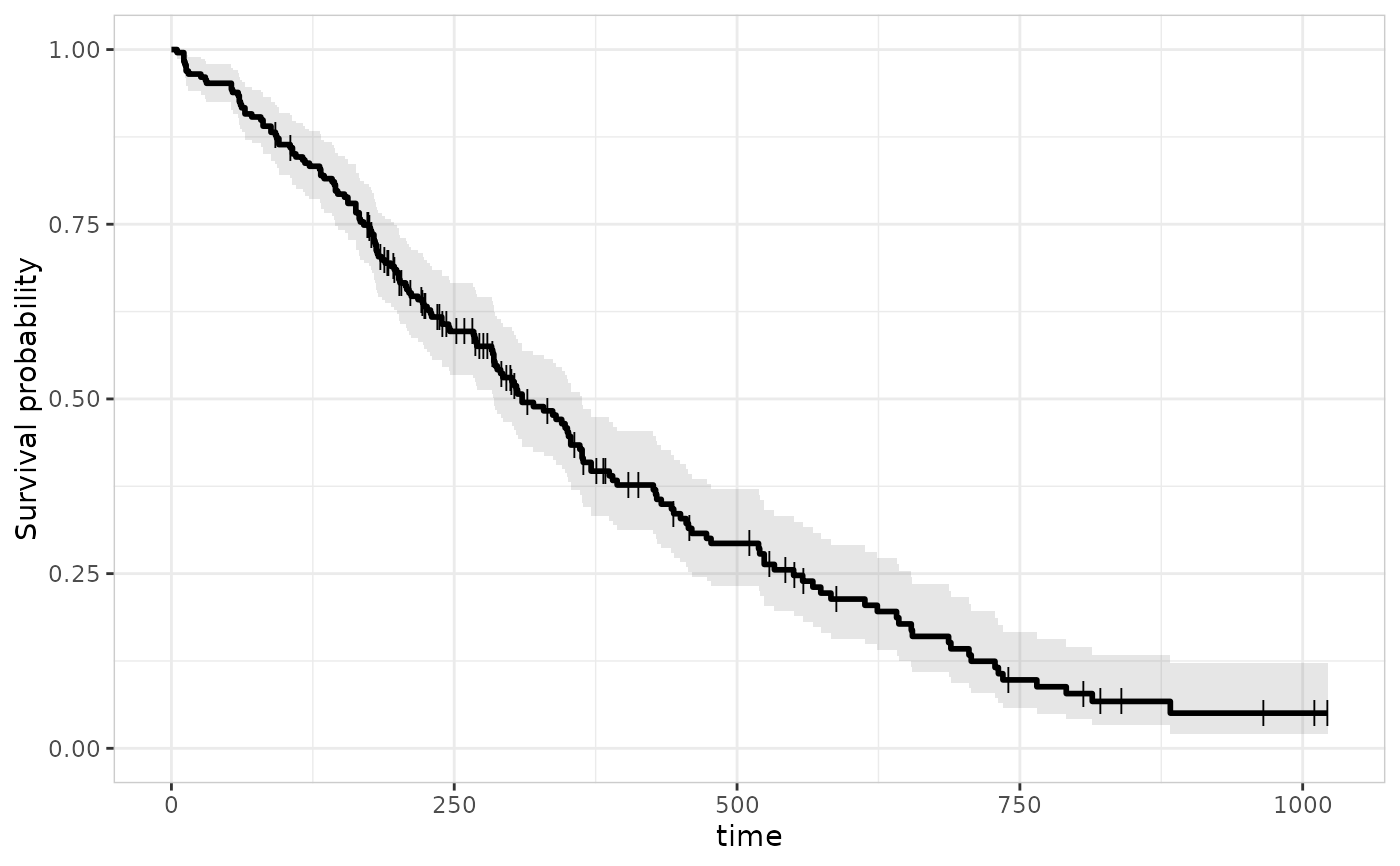
Builder functions for the censor layer (er_tte_add_censor()),
marking each censoring time directly on the Kaplan-Meier curve.
Usage
er_style_tte_censor_ticks(
  data,
  config,
  stratify,
  time,
  strata,
  theme,
  shape = 3,
  point_size = 2,
  stroke = 0.75,
  ...
)
Arguments
- data
The original data frame (
object$data).- config
Configuration for the censor layer (populated by
er_tte_add_censor()):config$table(the subset of the tidy KM table wheren_censor > 0, with astratacolumn when stratified).- stratify
Logical: whether the fit is stratified (
!is.null(object$strata)).- time
object$time(name/label/limits).- strata
object$strata(var/label), orNULLwhen unstratified.- theme
object$theme.- shape
Point shape for a censoring mark. Default
3(a plus sign), the conventional Kaplan-Meier censoring glyph.- point_size
Point size. Default
2.- stroke
Point stroke width. Default
0.75.- ...
Additional named arguments forwarded from
er_tte_add_censor()'s own....
Details
See er_style_tte() for the shared interface every TTE-grammar
builder implements.
A censoring-only row of the KM table (n_censor > 0, n_event == 0)
carries the survival value the curve already had going into that
time – Kaplan-Meier survival only drops at an event time – so a
mark drawn at (time, surv) lands exactly on the step curve without
any extra lookup.
Stratified colour maps to config$table's own strata column, the
same already-cleaned stratum label er_style_tte_curve_km() uses,
so a censoring mark takes on the colour of the curve it sits on. The
marks never contribute their own legend entry (show.legend = FALSE) – the curve layer's legend already identifies each stratum.
er_style_tte_censor_ticks() is tagged er_style_tag(fn, layer = "censor"), so er_tte_add_censor() errors informatively if handed
a builder tagged for a different layer.
Examples
library(survival)
lung |>
  er_tte(time, status == 2) |>
  er_tte_add_curve() |>
  er_tte_add_censor(style = er_style_tte_censor_ticks, shape = 124, point_size = 3) |>
  plot()